
NLP Core Competancies
- Posted by deborah on June 11th, 2007
Your Neuro Linguistic Programming (NLP) Certification Trainings meet (and exceeds) the standards of the American Board of Neuro Linguistic Programming and the Australian Board of Neuro Linguistic Programming.
On completion of this training you'll have access to membership of these professional bodies which help to support practitioners both at a national and international level.
An NLP Practitioner will...
Have completed a Minimum of 130 hours of training (7 days) in the basics of NLP patterns and skills, taught by a Certified Trainer.
Demonstration an ability to identify the following basic skills, techniques, patterns and concepts of NLP and to utilise them competently with self and others:
You may find that some of the language (NLP jargon)can be a little confusing, however you'll find below a brief explaination is included in these competencies to demonstrate how you could we use these theories and tecniques in a practical sense.
1. Behavioural integration of the basic presuppositions of NLP:
To be an effective practitioner whilst we acknowledge it is important to have a clear understanding and delivery of these specific skills and techniques, what is imperative is your relationship (with self; therapy clients and business customers). Change happens when you can build a supportive relationship and safe environment with all your clients. The NLP presuppositions are like beliefs or a code which allows our practitioners to provide the highest care, empathy and respect. You will find further explaination of these important NLP presuppositions on the page to follow.
If you would like the opportunity to work together with one of our certified practitioners, you can contact us directly on (02) 9389 7687 and will assist you in finding the right person for your specific needs.
2. Rapport, establishment and maintenance of rapport.
 Rapport is about the quality of your relationship, learning how to create instant rapport with all people is through a skill of matching and mirroring, this develops a mutual trust and responsiveness in all your relationships. With great rapport, others will feel comfortable in your presence, feel acknowledged and be more responsive to your views. Rapport can be instanteous and often evolves into an unconscious habit.
3. Pacing and Leading (verbal and non verbal).
This is an NLP skill which will enable you to positively influence your communication with integrity. Allowing you to help move a client or customer from an ineffective strategy or frame of mind into their desired new behaviour or an empowering emotional state. This specific skill is also often used effectively in hypnosis as well as in business relationships for negotiating conflict.
4. Sensory Acuity and Calibration (sensory based experience).
The ability to listen with more than just your eyes! Discover the other modalities of how to interprupt a persons reaction. (Do they really agree with your proposal?) find out how to pay careful attention to the subtle differences in voice and body language. You'll learn how to see if your message is getting across.
In business this technique is imperative for sales, in presentations, negotiations and in meetings. A skill which will help you to be flexible with your communication dependant on your observations (Do they reject or accept your ideas, proposal or product.)
5. Representational systems (predicates, and accessing cues).
It may suprise you that even though we converse in English - We don't all speak the same language. Learning more how we all process information differently; discover how to communicate using your customer or clients preferred "thinking system".
Observe what is behind the words they use and you can become aware of their eye patterns which will assist you to know the right cues on how you they process/access information and utilise their strategy for making decisions.
“Wow All the exercises compliment the theory for practical use, it was a fun way to learn and very effective… Yes, I’ve transformed my thinking, and I'm looking forward to transform more and more… Everything was so well organised, superb!” Tash Singh
6. The Meta-Model.
The verbal language we use is only 7% of how we communicate. This linguistic tool will enhance your own effective questioning techniques and allow you to predict and unconver information that may be unconsciousness to your client. Learn how to gather information and help to define and clarify their specific needs. So you can provide them with a rich and rewarding experience.
7. Milton-Model.
Based on the work and language skills of Milton Ericson. Hypnotic language patterns can induce many different levels of trance and is useful for direct another persons line of thinking (by being "artfully vague"). Are you aware that this type of language patterns are often used today in: politics; advertising and sales? Many are not even aware of their own hypnotic language! Wouldn't it be beneficial to know when someone is using these types of language patterns with you?
8. Elicitation of well-formed, ecological outcomes and structures of present state.
Respect and integrity is integral to all NLP techniques and skills. From this perspective, we ensure the client is clear about their specific needs and outcomes. Helping to structure and get the clarity of their desired outcomes. It is then we can be of high benefit and value as we can together design and plan the most appropriate strategy for their specific [ersonal needs,goals and outcomes.
 9. Overlap and Translation.
The human being is complex and unique. As an NLP practitioner there is a level of skill in helping to facilitate behavioural change in others (or self) by simply accessing different parts of their own experience. Often this new experience can gain the necessary perspective and know how for relevant change.
10. Metaphor creation.
Metaphors are something we use daily, all our language is metaphorical. In NLP we use this story telling to help teach or explain a complex concept or process, they can be used therapeutically as well as in business. Metaphors include figures of speech, stories, and parables. Metaphors can be powerful way to learn. They are often used in hypnosis to assist the client with new structures of behaviours/thinking patterns and are very helpful when communicating important messages with children.
11. Frames; contrast, relevancy, As If, Backtrack.
The meaning we derive from any experience depends on the frame in which it is applied. Framing looks behond the boundaries that you would normally set in time, space and people. Allowing you to changing the way in which you (or others) may judge an experience.
12. Anchoring.
Anchors are Visual, Auditory or Kinaesthetic and are based on the skill of linking a specific feeling and associating it to a specific stimulae. Creating a strong resource anchor is a common technique to assist people with public speaking, phobia's as well as moving people from a behaviour of procrastination to action and motivation.
13. Anchoring Techniques (contextualised to the field of application).
Anchoring can stimulate action or change behaviours and moods of situations or events. Anchoring skills include techniques such as Resource Anchoring; Stacking Anchors; Collalapesed Anchors and Chaining Anchors. We will demonstrate how to anchor both from a therapeutic aspect (where we use the knuckles on a clients hand) as well as how we create anchors with our words, behaviours and learn about the unconscious anchors we experience every day. Different aspects of anchoring are taught at the practitioner level of NLP and further advanced techniques at the Master Practitioner level.
14. Ability to shift consciousness to external or internal, as required by the moment's task.
An important skill of NLP to be aware of your conscious processing and attention, being able to be flexible according to the situation or event. In a therapeutic situation it is important for the therapist to connect with their client and also recognise issues which may be the therapists own personal challenges and not the issues of the client. (also refered to as bracketing)
15. Dissociation,Association and Perceptual Positions.
This is the distinction for all possible states and mindsets. Associated is being in the moment and feeling the feelings which go with the experience. When you are disociated you are more detached from the event and feelings from a distance. These are key for the success of many of the NLP tools and techniques.
16. Chunking.
The word "chunking" refers to a strategy of recoding our language, chaning the perception and the grouping of information in respect to the specific person with whom you are liaising. Flexibility of language is imperative in both business and in therapy. You will learn how to easily traverse from one level of thinking (and language) to another, dependant on the specific event, situation or person.
 17. Sub Modalities.
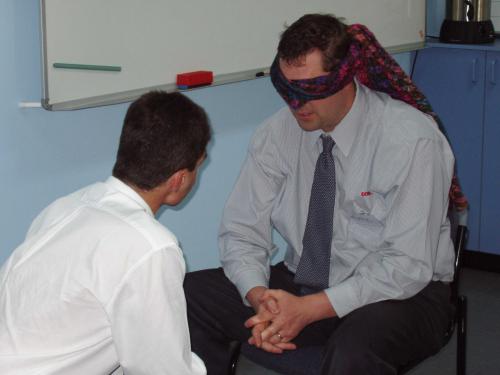
Submodalities are based on how we structure our experience, they are the building blocks or detail of our main senses of Visual (visual), Auditory (sounds), Kinesthetic (feelings), Olfactory (smells), Gustatory (tastes) and Auditory Digital (labels). There are numerous way in which you can creatively change beliefs, values and the way in which one structures their internal thoughts.
18. Verbal and non-verbal elicitation of responses.
Paying attention to the verbal and non verbal responses of yourself and others in order to elicit, develop or change behaviours or states to a more effective and desired outcome.
19. Accessing and building of resources.
The level of your personal experience and ability to be resourceful in seeking out knowledge, skills and abilities that may be beyond your current skill or knowledge level.
For communication excellence and the science and art of achievement, this is the training to attend! - Loke Kok Wah,Trainer with Southern Bank Kuala Lumpur, Malaysia
20. Reframing.
Reframing is a communication technique which allows the understanding an experience from a different perspective. Effective reframing may changing the meaning or the context of the situation, event or negative belief. Especially useful for any objections which you may encounter from clients or customers, when mediating or negotiating conflict, it can assist others to manifest new possibilities and deal with negative situations more effectively.
21. Strategies; detection, elicitation, utilisation, & installation.
We all run our own strategies at an unconscious level. Strategies are simple patterns of behaviour which consistently produce a particular outcome. By learning the skill of detecting stategies (through either eye patterns and/or language) we can utlise the strategies which work best for us and change the strategies which are ineffective. A powerful tool in helping people make important decisions.
22. Demonstration of behavioural flexibility.
When what you are doing is not hitting the mark, it's imperative to first recognise and acknowledge this (developing acute awareness and sensory aquity skills of observation in yourself and others). The next important step is your skill and expertise to change it by utilising your language patterns (eg. milton model, meta model, reframing etc), strategies (decision making; buying strategy; convincer strategy). The combination of your knowledge, experience and skill can make the difference in all your interpersonal interactions. The more choice and flexibility you have the better your result.